Gold mining
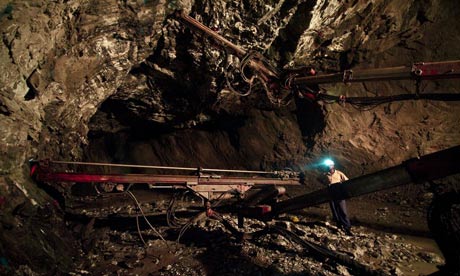
It is impossible to know the exact date that humans first began to mine gold, but some of the oldest known gold artifacts were found in the Varna Necropolis in Bulgaria. The graves of the necropolis were built between 4700 and 4200 BC, indicating that gold mining could be at least 7000 years old.
Bronze age gold objects are plentiful, especially in Ireland and Spain, and there are several well known possible sources. Romans used hydraulic mining methods, such as hushing and ground sluicing on a large scale to extract gold from extensive alluvial deposits, such as those atLas Medulas. Mining was under the control of the state but the mines may have been leased to civilian contractors some time later. The gold served as the primary medium of exchange within the empire, and was an important motive in the Roman invasion of Britain byClaudius in the first century A.D., although there is only one known Roman gold mine at Dolaucothi in west Wales. Gold was a prime motivation for the campaign in Dacia when the Romans invaded Transylvania in what is now modern Romania in the second century A.D. The legions were led by the emperor Trajan, and their exploits are shown on Trajan's Column in Rome and the several reproductions of the column elsewhere (such as the Victoria and Albert Museum in London).[1] Under the Eastern Roman Empire Emperor Justinian's rule, gold was mined in the Balkans, Anatolia, Armenia, Egypt, and Nubia.[2]
In the area of the Kolar Gold Fields in Bangarpet Taluk, Kolar District of Karnataka state, India, gold was first mined prior to the 2nd and 3rd century A.D. by digging small pits. (Golden objects found in Harappa and Mohenjo-daro have been traced to Kolar through the analysis of impurities — the impurities include 11% silver concentration, found only in KGF ore.) The Champion reef at the Kolar gold fields was mined to a depth of 50 metres (160 ft) during the Gupta period in the fifth century A.D.. During the Chola period in the 9th and 10th century A.D., the scale of the operation grew.[citation needed] The metal continued to be mined by the eleventh century kings of South India, the Vijayanagara Empire from 1336 to 1560, and later by Tipu Sultan, the king of Mysore state and the British. It is estimated that the total gold production in Karnataka to date is 1000 tons.[citation needed]
The mining of the Slovak deposit primarily around Kremnica was the largest of the Medieval period in Europe.[3]
During the 19th century, numerous gold rushes in remote regions around the globe caused large migrations of miners, such as the California Gold Rush of 1849, the Victoria Gold Rush, and the Klondike Gold Rush. The discovery of gold in the Witwatersrand led to the Second Boer War and ultimately the founding of South Africa.
The Carlin Trend of Nevada, U.S., was discovered in 1961. Official estimates indicate that total world gold production since the beginning of civilization has been 4,970,000,000 troy ounces (155,000 t) and total Nevada production is three percent of that, which ranks Nevada as one of the Earth's primary gold producing regions.[4]